
The AI Workflow Stack Every PM Is Expected to Understand Now
Breaking Down the Layers That Power Today’s AI Products

Most PMs think they’re behind on AI tools.
What they’re actually behind on is how work flows now.
Let’s start with something uncomfortable.
Most PMs aren’t struggling with AI because they’re bad at prompting.
They’re struggling because the PM job quietly changed, and nobody stopped to explain how.
The teams didn’t announce it.
Job descriptions didn’t update clearly.
No one said, “Hey, your mental model for product work is outdated.”
But expectations shifted anyway.
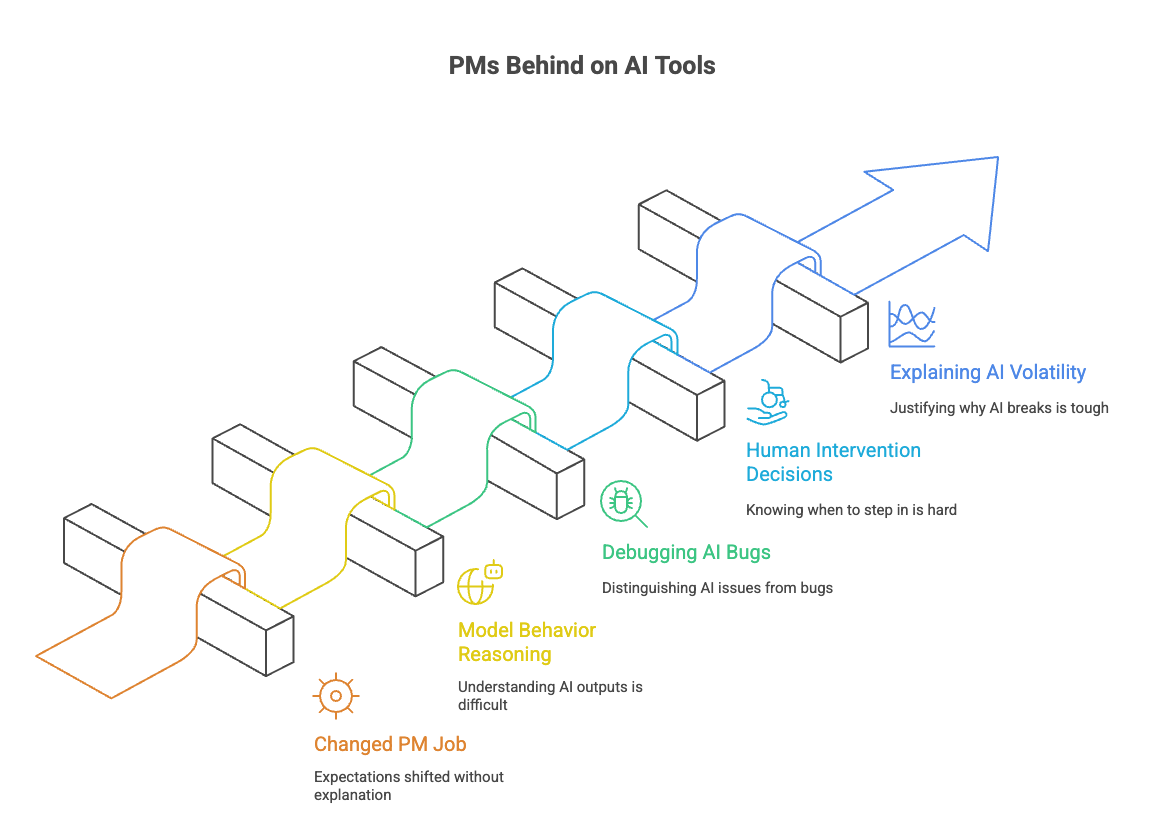
Suddenly, PMs are expected to:
reason about model behavior
understand why outputs drift
debug “AI bugs” that aren’t really bugs
decide when humans should step in
explain why something worked last week but broke today
And many PMs are left thinking:
“I’m doing everything right… So why does this feel harder?”
This post is about that gap.
The mistake PMs are making
Most PMs approach AI like this:
“What AI feature should we add?”
That framing worked in the old world.
In the new world, the real question is:
“How does work move through this system - and where does AI change the flow?”
That’s the shift.
AI didn’t just add features.
It rewired workflows.
And PMs are now expected to understand the AI workflow stack, whether or not anyone calls it that.
Why “knowing AI” isn’t enough anymore
You can:
know what an LLM is
understand RAG at a high level
use ChatGPT daily
…and still struggle badly as a PM on an AI product.
Because what matters now isn’t knowledge of components.
It’s understanding how they connect.
The job moved from:
managing outputs
to
managing systems that produce outputs
That’s a different skill entirely.
The AI workflow stack
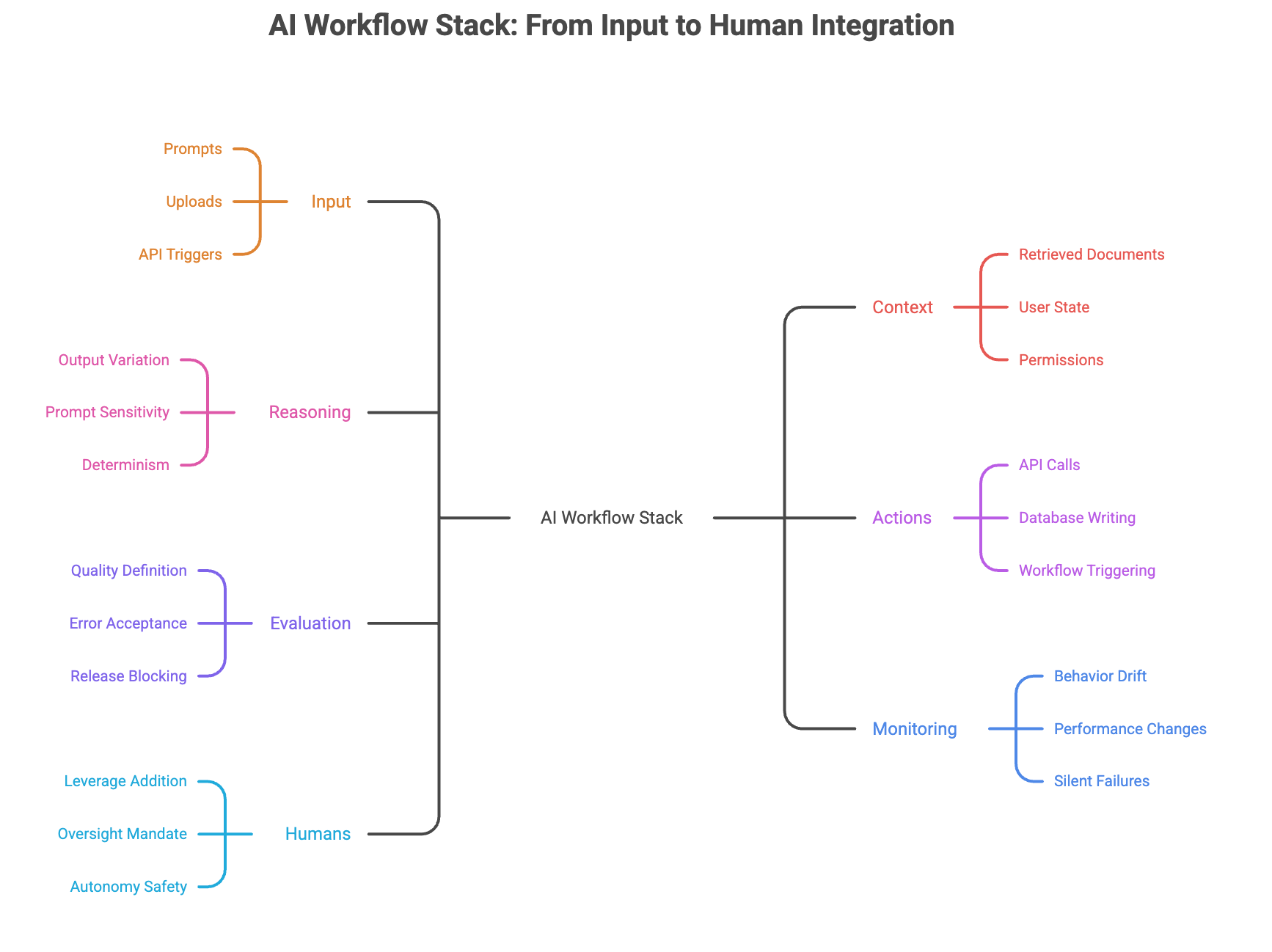
Every modern AI product - chatbots, copilots, agents, internal tools - runs on the same basic flow.
Not theory.
Not buzzwords.
This is what actually happens in production.
1. Input: where messiness begins
This is where users interact:
prompts
questions
uploads
events
API triggers
Here’s the thing PMs underestimate:
Most AI failures start here.
Ambiguous input.
Conflicting intent.
Users asking for things the system was never designed to handle.
Good PMs obsess over:
what inputs are allowed
when the system should ask clarifying questions
how failure is communicated
what “good input” even means
This is not UX polish.
This is system survival.
2. Context: what the AI actually knows
This layer decides whether the AI is:
helpful
confident
hallucinating
useless
Context includes:
retrieved documents
user state
history
permissions
memory
system instructions
Most PMs think hallucinations are a “model problem”.
They’re usually a context problem.
PMs who understand this stop arguing about models and start fixing data flow.
3. Reasoning: where unpredictability comes from
This is the LLM itself.
And here’s the hard truth:
Bigger models don’t save bad workflows.
PMs don’t need to tune weights.
But they do need to understand:
why outputs vary
why small prompt changes cause regressions
why “it worked yesterday” means nothing
why determinism is rare and dangerous to assume
This is where PMs learn to stop promising certainty.
4. Actions: where AI stops being a demo
Talking AI is easy.
Doing AI is hard.
This layer is about:
API calls
writing to databases
triggering workflows
sending messages
executing steps
This is where PMs decide:
what the AI is allowed to do
what needs approval
what can be undone
what absolutely must not fail
This is product judgment - not engineering detail.
5. Evaluation: the part PMs don’t realize they own
Traditional products had QA.
AI products have continuous evaluation.
Someone has to decide:
what “good” looks like
what failure is acceptable
which errors matter
when to block releases
when to roll back behavior
That “someone” is increasingly the PM.
If you don’t define quality,
the system slowly degrades - quietly.
6. Monitoring: why AI products age fast
AI products don’t break loudly.
They decay.
Quality drops.
Edge cases grow.
User trust erodes.
PMs are now expected to notice:
behavior drift
performance changes
confidence mismatches
silent failures
This is why AI PMs think in loops, not launches.
7. Humans: still in the system, just differently
The best AI products don’t remove humans.
They place them carefully.
PMs decide:
where humans add leverage
where they slow things down
where oversight is mandatory
where autonomy is safe
This is not a safety checkbox.
It’s product design.
Why this stack changes PM careers
Here’s what no one says out loud:
PMs are already being evaluated on this understanding.
Not formally.
Not explicitly.
But in meetings, reviews, and hiring decisions.
You can see it when:
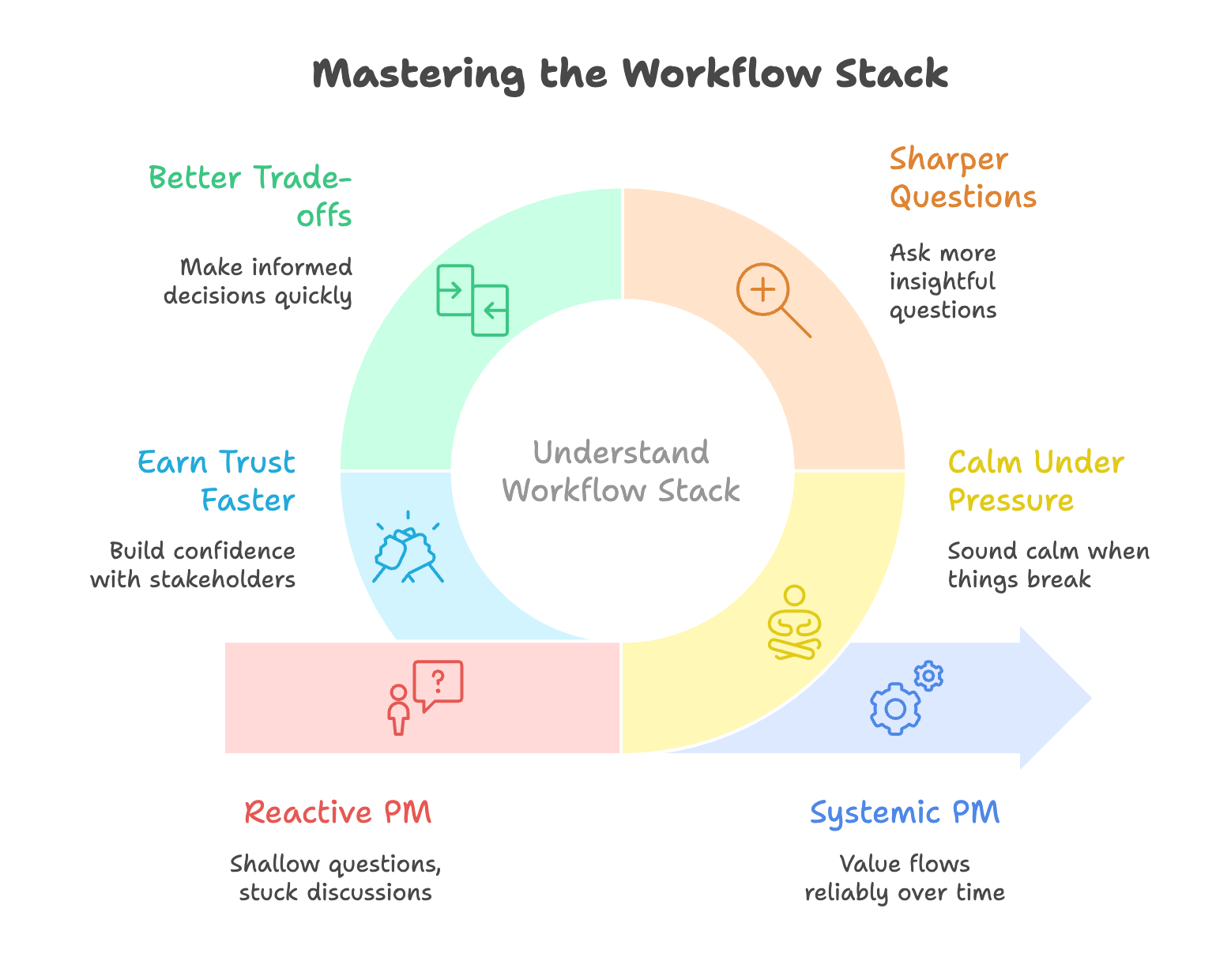
PMs ask shallow questions
discussions get stuck on tools
quality issues surprise people
failures feel mysterious instead of diagnosable
PMs who understand the workflow stack:
sound calm when things break
ask sharper questions
make better trade-offs
earn trust faster
PMs who don’t:
feel reactive
rely on engineers to explain everything
struggle to lead ambiguity
The real shift
The PM job didn’t become “more technical”.
It became more systemic.
From:
“What should we build?”
To:
“How does value reliably flow through this system over time?”
That’s the new bar.
You don’t need to chase every AI tool.
You don’t need to become an ML expert.
But you do need to understand how AI changes the shape of work.
Because PMs are no longer judged by how well they explain ideas
They’re judged by how well they design systems that keep working.
And this AI workflow stack?
It’s already the baseline.
This framework really hits…once you map how work flows instead of just what tools you use, you unlock where AI actually adds value