
AI Features Aren’t Enough: The Shift to Owning AI Systems
The hidden responsibilities behind “AI-powered”

Most PMs today are building AI features.
Very few are owning AI systems.
That difference will define who stays relevant
and who slowly loses influence in AI-driven teams.
AI hasn’t changed what PMs ship.
It has changed what PMs are responsible for.
Yet most product organizations are still operating as if:
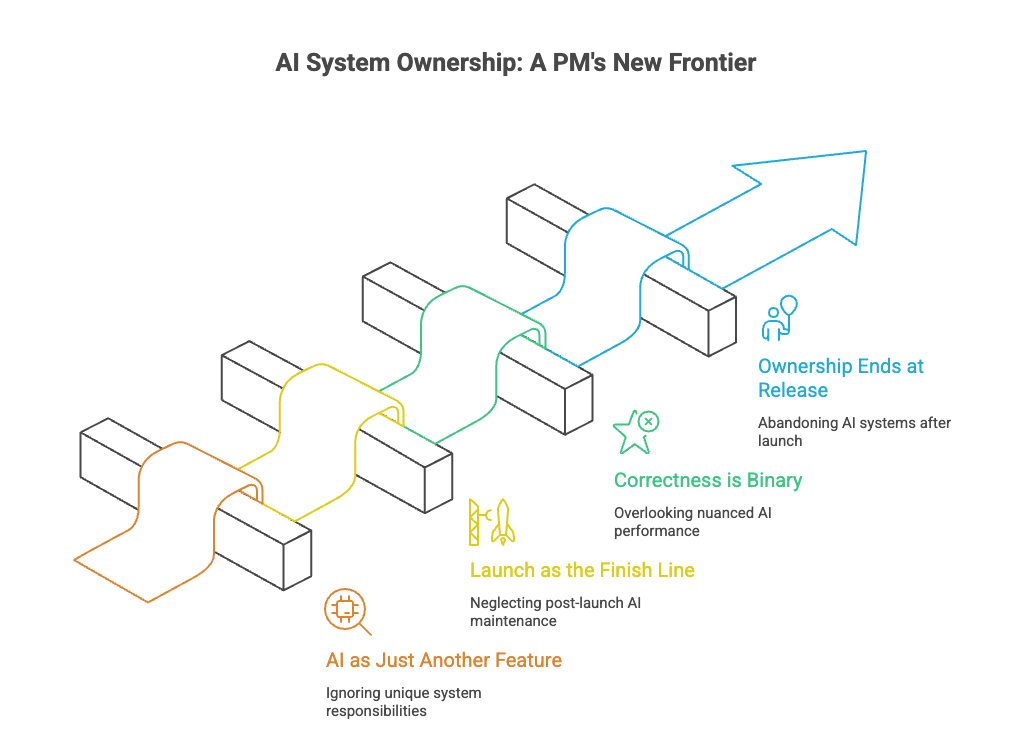
AI is just another feature
launch is the finish line
correctness is binary
ownership ends at release
That mental model no longer works.
This post explains the critical difference between building AI features and owning AI systems, why most PMs are stuck on the wrong side of it, and what true AI system ownership actually looks like.
Why This Distinction Matters Now
In traditional software:
features were discrete
behavior was deterministic
failure was obvious
ownership boundaries were clean
In AI products:
behavior is probabilistic
outputs evolve over time
failures are subtle
responsibility is blurred
That means PMs can no longer optimize for:
“Did we ship the feature?”
They must optimize for:
“Does the system continue to behave correctly?”
That is not feature thinking.
That is system ownership.
What Building AI Features Looks Like
Most PMs today are doing this often unknowingly.
Feature-oriented AI PM behavior:
define an AI capability (summarize, recommend, chat)
write PRDs describing user flows
collaborate on prompt design
launch behind a feature flag
track adoption metrics
move on to the next roadmap item
This feels productive.
It looks like progress.
But it assumes AI behaves like software.
It doesn’t.
What Owning AI Systems Looks Like
System-oriented PMs think very differently.
They focus on:
behavior over time
failure modes
quality decay
human fallback paths
evaluation pipelines
governance boundaries
They don’t ask:
“Did we ship?”
They ask:
“What happens when this degrades?”
That single question changes everything.
Feature PM vs System PM
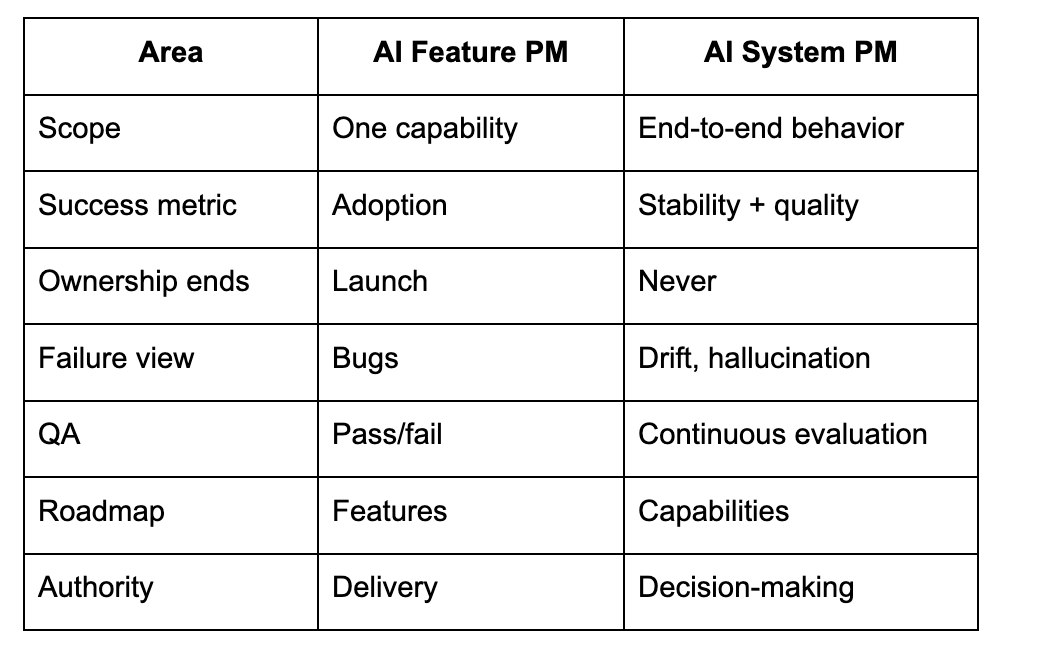
This is not a maturity ladder.
It’s a mindset shift.
Why Feature Thinking Fails for AI
1. AI Does Not Stay the Same After Launch
Models drift.
Data changes.
User behavior evolves.
A feature mindset assumes stability.
AI guarantees instability.
2. AI Failures Are Behavioral, Not Binary
There is no “broken” state.
There is only:
less accurate
less grounded
more hallucination-prone
subtly wrong
Feature metrics don’t catch this.
3. Ownership Gets Diffused
When AI fails, teams ask:
Was it the model?
the prompt?
the data?
infra?
User misuse?
Without a system owner, no one truly owns the outcome.
That owner must be the PM.
The Core Shift: From Shipping to Stewardship
Owning AI systems means PMs move from:
planners - stewards
writers - operators
deliverers - governors
Their job becomes:
defining acceptable behavior
deciding error boundaries
monitoring degradation
triggering interventions
explaining failures to leadership
This work is ongoing.
It doesn’t fit neatly into sprints.
That’s why many PMs unconsciously avoid it.
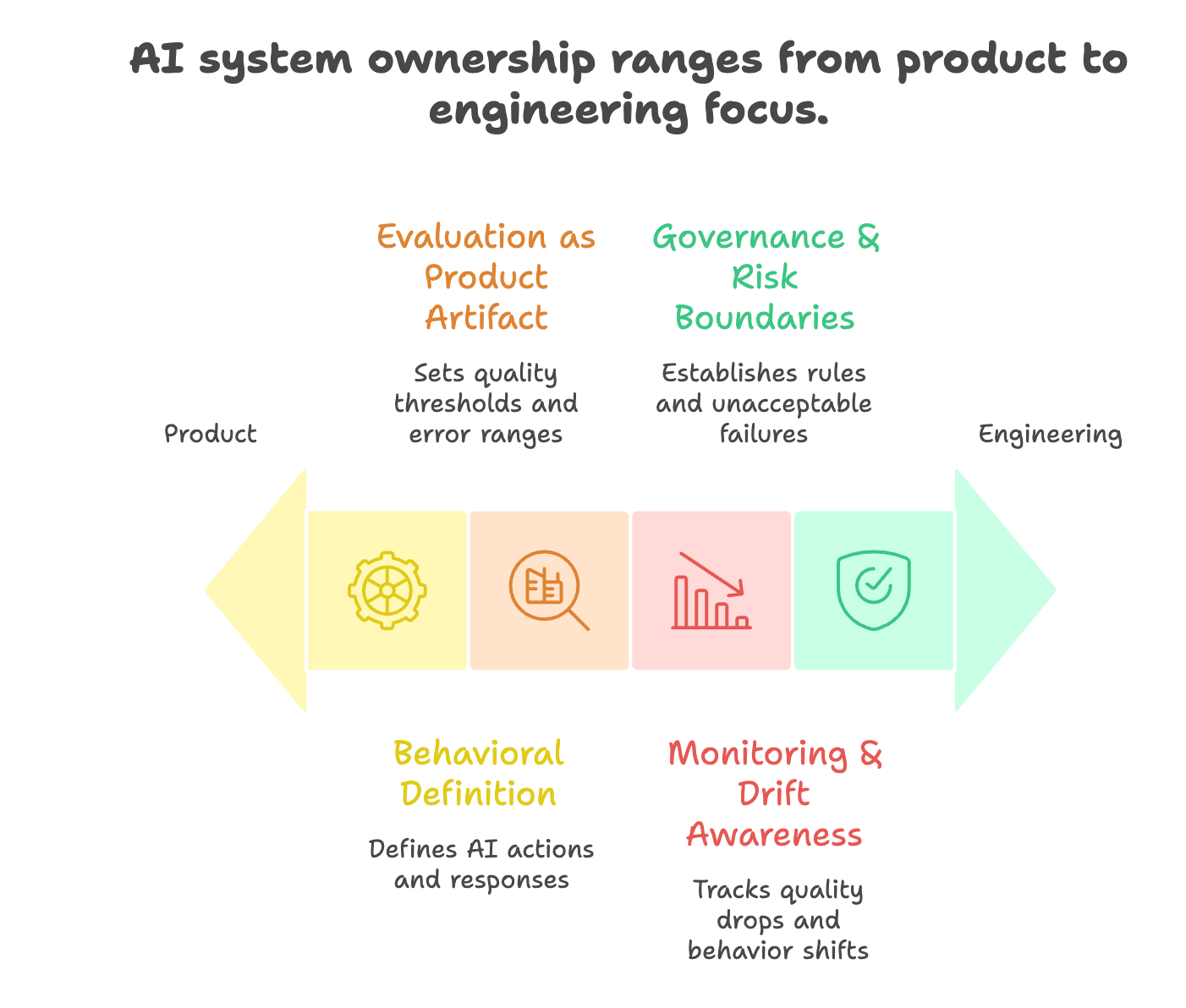
What AI System Ownership Actually Includes
Here is what system PMs explicitly own:
1 Behavioral Definition
Not just what the AI does, but:
when it should refuse
when it should escalate
when it should ask for clarification
when it should fall back
This is product work not engineering.
2 Evaluation as a Product Artifact
System PMs own:
evaluation criteria
quality thresholds
acceptable error ranges
trade-offs between accuracy, latency, and cost
They don’t treat evals as QA.
They treat evals as product truth.
3 Monitoring & Drift Awareness
Owning a system means knowing:
when quality drops
when behavior shifts
when confidence increases incorrectly
when outputs diverge from intent
If PMs don’t own this, no one does.
4 Governance & Risk Boundaries
AI systems need explicit rules:
what the system must never do
what data it can access
what outputs require review
what failures are unacceptable
This is product judgment, not compliance paperwork.
Why Many PMs Get Stuck at Feature Level
Three reasons:
Comfort with Traditional PM Skills
Roadmaps, PRDs, stakeholder alignment familiar territory.
System ownership requires:
technical literacy
probabilistic thinking
ambiguity tolerance
long-term accountability
Not all PMs are ready for that shift.
Organizational Incentives
Most orgs reward:
launches
visibility
delivery velocity
They don’t reward:
preventing failures
reducing drift
maintaining stability
System PMs often do invisible work until something breaks.
Fear of Responsibility
Owning systems means owning failures without clear blame.
Many PMs prefer shared responsibility.
AI systems punish that mindset.
How PMs Transition from Feature Builders to System Owners
This transition is learnable.
Step 1: Change the Question You Ask
Stop asking:
“What should we build next?”
Start asking:
“What could go wrong over time?”
Step 2: Own One System Metric
Pick one:
hallucination rate
eval score
fallback frequency
user correction rate
Make it your metric.
Step 3: Redefine the Roadmap
Replace feature items with:
improve grounding reliability
reduce error variance
add fallback paths
tighten behavior boundaries
This reframes how leadership sees AI work.
The Career Implication PMs Miss
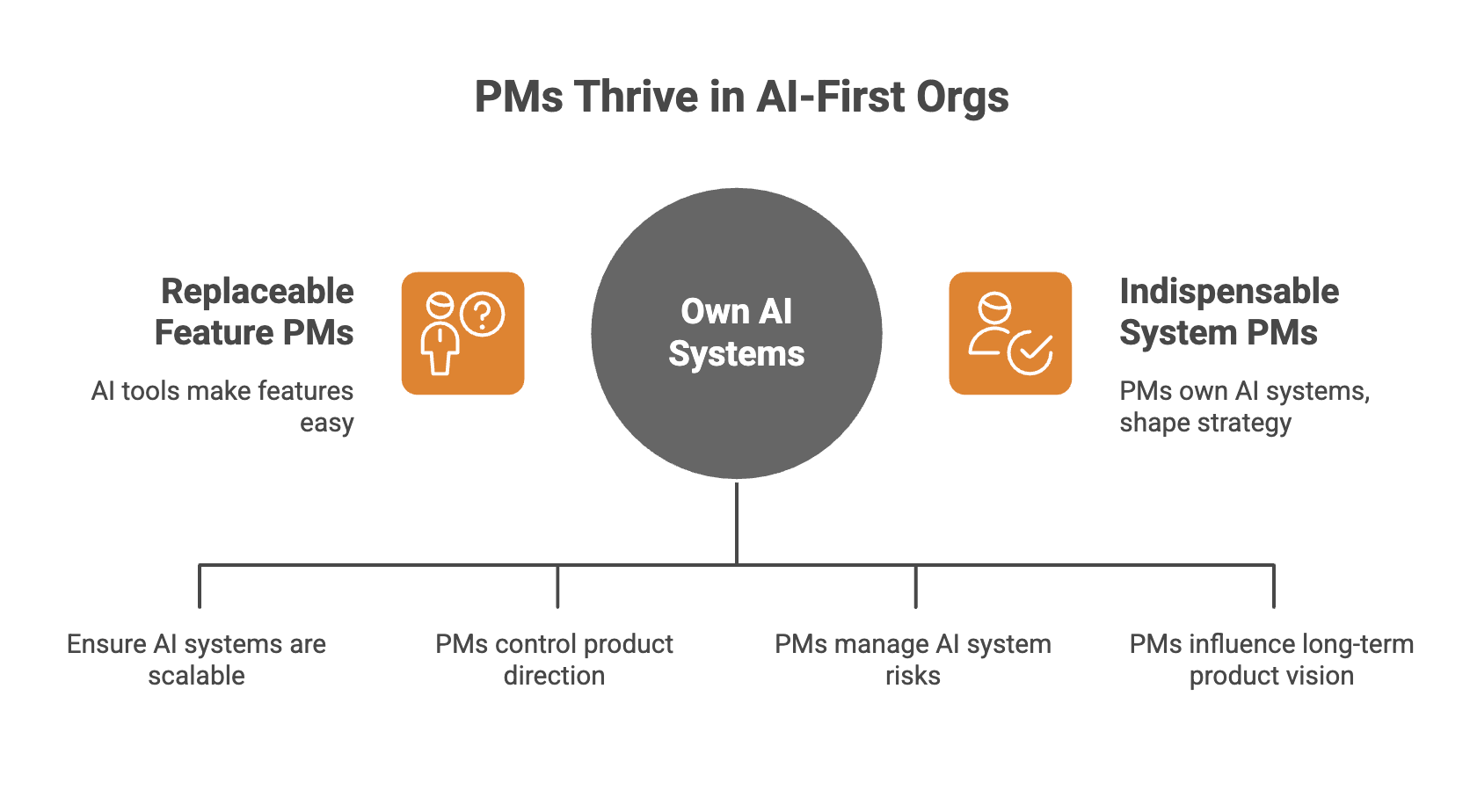
In AI-first orgs:
feature PMs become replaceable
system PMs become indispensable
Why?
Because anyone can ship a feature with AI tools.
Very few people can keep AI systems reliable at scale.
That skill compounds.
Building AI features is table stakes.
Owning AI systems is the job.
PMs who stop at features will:
lose influence
get bypassed in decisions
be seen as coordinators
PMs who own systems will:
define product truth
control risk
shape strategy
earn long-term trust
AI didn’t eliminate the PM role.
It raised it.
But only for PMs willing to move
from shipping things
to owning behavior.
Didn't expect this take, but your distinction is spot on. How do large organisations actually foster this system ownership for their PMs? Brilliant insight.